

There is a saying that we die twice:
The first time being our physical death.
The second being when our name is mentioned for the last time.
「人は二度死ぬ」と言われます。
一度目は肉体の死
二度目は、その名前がもはや口にされなくなったときです。
When You Call My Name is a collaborative project honouring civilians who were brought from Southeast Asia, the Pacific Islands, across Australia and Aotearoa / New Zealand as ‘Japanese enemy aliens’ to be interned in Australia and Aotearoa / New Zealand during World War II, and died during internment.
They include 26 people from Taiwan and one from Korea, who were included among the Japanese because Taiwan and the Korean Peninsula were under the rule of Japan during the Pacific War. There are also three people from Thailand, who were originally interned in Aotearoa / New Zealand, and died in a plane crash on their way to be interned in Australia.
192 people are now buried in the Japanese Cemetery in Wiradjuri Country in Cowra, New South Wales, Australia; 12 people who died in the plane crash are buried at the Waikumete Cemetery in Tāmaki Makaurau / Auckland; two who died on the voyage to Australia from Indonesia (the then Dutch East Indies) were buried at sea; the remains of one who died on Matiu / Somes Island were taken back to his family in Tonga by a friend; and one is unknown.
While the civilian internees died in various parts of Australia, their remains were transferred to Cowra in the 1960s, and consolidated in the Japanese Cemetery. Japanese prisoners of war who had died in a prison breakout, known as the Cowra Breakout, were already buried there, and their graves were being cared for by the local residents. When the Japanese government proposed that the civilian internees’ remains be re-interred in Cowra, the community responded positively. The Japanese Cemetery in Cowra was officially opened on 22 November 1964.
There is a saying that we die twice. The first time being our physical death. The second being when our name is mentioned for the last time. With this saying in mind, our project facilitators called on their respective communities to take part in this collaborative project, and gave each participant information about a particular deceased internee to ‘adopt’. The participant was then asked to respond to their learnings with an artwork, or a photograph of a work. The only prerequisite was that the artwork include the name of their ‘adopted’ internee. The project brings together 225 artworks created by 166 artist/participants, honouring 208 internees. Some internees were ‘adopted’ by more than one artist.
The information about the internees we provided was mostly based on research by Dr Yuriko Nagata for the Cowra Japanese War Cemetery Online Database, and documents available online at the time, held at the National Archives of Australia. The information about internees who died in Aotearoa / New Zealand was researched by Dr Sophie Constable at the Te Rua Mahara o te Kāwanatanga Archives New Zealand and Waipapa Taumata Rau University of Auckland Library, expanding on existing work by Professor Judith A. Bennett. Some of our participants conducted further research into their ‘adopted’ internees through other libraries and archives, sometimes even their own family archives.
The artworks on this website were incorporated into a large-scale group collage. Workshops to create the collage, along with its exhibition and the official project launch, were held at the School of Culture, History & Language within the College of Asia and the Pacific at the Australian National University in September 2025. The project continues to evolve, with new collages being created and new workshops continuing to take place.
More information about the project, its history, and upcoming programs can be found throughout this website. The thumbnail images in the Gallery do not do justice to the creativity of the artist/participants. The artworks are intended to be viewed at a larger scale, and we encourage you to visit one of our exhibitions or select an image in the Gallery to view it in full.
We’ve taken great care, but some visuals, language, or descriptions may be culturally sensitive or not typically used in certain public or community settings. This is especially true given the diverse cultural perspectives in a project like this. Some terms or annotations reflect the views of their time or origin, and may be seen as inappropriate today, or in the future.
However, despite differences, we have created this group work in the hope that we will never repeat this history of civilian internment, and to speak out for peace.
This project would not have been possible without the kind and generous support of our partners and sponsors, the expertise of our dedicated volunteers (and their many long hours of work), and the heartfelt words and artistic skills of our talented participants.
Mayu Kanamori
on behalf of When You Call My Name team
August 2026
Click here to view the details and guidelines of the callout for artworks.
When You Call My Name
「When You Call My Name」は、第二次世界大戦中に「日本人敵性外国人」として東南アジア、太平洋諸島、オーストラリア各地、そしてアオテアロア/ニュージーランドからオーストラリアおよびアオテアロア/ニュージーランドへ移送され、抑留中に亡くなった民間人たちを追悼する共同プロジェクトです。
その中には、台湾出身者26名と朝鮮出身者1名も含まれています。当時、台湾と朝鮮半島は日本統治下にあったため、彼らも「日本人」として扱われました。また、もともとアオテアロア/ニュージーランドで抑留され、オーストラリアへ移送される途中の飛行機事故で亡くなったタイ出身者3名も含まれています。
192名は現在、オーストラリア・ニューサウスウェールズ州、ウィラジュリの地(Wiradjuri Country)にあるカウラ日本人墓地に埋葬されています。飛行機事故で亡くなった12名は、タマキ・マカウラウ/オークランドのワイクメテ墓地に埋葬されています。また、インドネシア(当時のオランダ領東インド)からオーストラリアへ向かう航海中に亡くなった2名は海へ葬られ、マティウ/ソームズ島で亡くなった1名の遺骨は、友人によってトンガの家族の元へ返されました。そして1名については、現在も詳細が不明です。
これらの民間抑留者たちはオーストラリア各地で亡くなりましたが、その遺骨は1960年代にカウラへ移送され、日本人墓地に合葬されました。そこにはすでに「カウラ事件(Cowra Breakout)」として知られる捕虜脱走事件で亡くなった日本人捕虜たちが埋葬されており、地域住民によって墓地が大切に守られていました。日本政府が民間抑留者たちの遺骨をカウラへ改葬することを提案した際、地域社会はこれを温かく受け入れました。そして1964年11月22日、カウラ日本人墓地は正式に開園しました。
「人は二度死ぬ」という言葉があります。
一度目は肉体的な死。
二度目は、その人の名前が最後に呼ばれた時。
私たちのプロジェクト・ファシリテーターは、この言葉を胸に、それぞれのコミュニティへ参加を呼びかけ、参加者一人ひとりに特定の故人となった抑留者についての情報を託しました。参加者は、その人物について学んだことに応答する形で作品、または作品写真を制作しました。唯一の条件は、作品の中に「託された」抑留者の名前を含めることでした。
このプロジェクトでは、166名のアーティスト/参加者によって制作された225点の作品を通じて、208名の抑留者を追悼しています。中には複数のアーティストによって「託された」抑留者もいます。
私たちが提供した抑留者に関する情報の多くは、カウラ日本人戦争墓地オンラインデータベースのために永田百合子博士が行った調査、および当時オンラインで閲覧可能だったオーストラリア国立公文書館(National Archives of Australia)の資料に基づいています。また、アオテアロア/ニュージーランドで亡くなった抑留者に関する情報は、ソフィー・コンスタブル博士が、テ・ルア・マハラ・オ・テ・カーワナタンガ(ニュージーランド国立公文書館)およびオークランド大学図書館にて調査を行い、ジュディス・A・ベネット教授による既存研究をさらに発展させたものです。
さらに、一部の参加者は、それぞれの「託された」抑留者について、他の図書館や公文書館、時には自らの家族資料を通じて独自の追加調査を行いました。
このウェブサイトに掲載されている作品は、大規模な共同コラージュ作品に組み込まれました。コラージュ制作のためのワークショップ、展示、そして正式なプロジェクト・ローンチは、2025年9月にオーストラリア国立大学(Australian National University)アジア太平洋学部内、文化・歴史・言語学科(School of Culture, History & Language)にて開催されました。プロジェクトはその後も発展を続け、新たなコラージュの制作やワークショップが継続して行われています。
このプロジェクトの詳細、これまでの歩み、今後のプログラムについては、このウェブサイト内でご覧いただけます。ギャラリーに掲載されているサムネイル画像だけでは、アーティスト/参加者の創造性を十分にお伝えすることができません。作品はより大きなサイズで鑑賞されることを想定しています。ぜひ展示会へお越しいただくか、ギャラリー内の画像を選択して拡大表示でご覧ください。
私たちは細心の注意を払っていますが、一部のビジュアル、言葉、表現には、文化的に配慮が必要なものや、特定の公共・コミュニティ環境では一般的でないものが含まれている可能性があります。これは、このような多様な文化的背景を持つプロジェクトにおいて特に当てはまります。また、一部の用語や注釈は、その時代や資料の背景を反映したものであり、今日、あるいは将来的には不適切と受け取られる場合があります。
しかし、私たちは、この民間人抑留の歴史を二度と繰り返さないために、そして平和への願いを伝えるために、違いを超えてこの共同作品を創り上げました。
このプロジェクトは、パートナーおよびスポンサーの皆さまからの温かく惜しみないご支援、献身的なボランティアの専門知識と長時間にわたる努力、そして参加者の皆さまによる心のこもった言葉と豊かな芸術的表現なしには実現しませんでした。
2026年8月
When You Call My Name チームを代表して
金森マユ
作品募集の詳細およびガイドラインはこちらをご覧ください。
The Gallery page contains the 225 artworks created by 166 artist/participants, honouring 208 internees

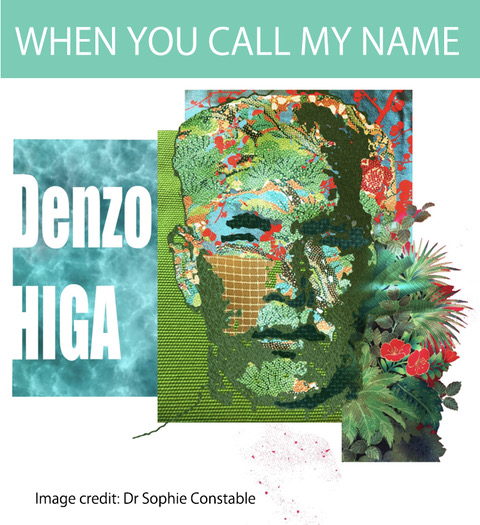
Denzo was born in Okinawa Prefecture, Japan. He was working as a farmer in Touho, New Caledonia. He was married, and had four sons and four daughters. He was 61 years old.
We thank the Higa family for consenting to Sophie’s digital quilt portrait of their ancestor Denzo to be used as the flagship image for the When You Call My Name project.
比嘉氏は沖縄県出身の農夫で、ニューカレドニアのトゥオに住んでいました。家族は妻と8人の子ども(4男4女)。 61歳で亡くなりました。
本プロジェクトの象徴として肖像の使用を許可してくださった比嘉家の皆さまに感謝申し上げます。
Cowra Japanese Cemetery Online Database / History of Civilian Internment
民間人抑留の歴史
カウラ日本人戦争墓地オンラインデータベース
カウラ日本人墓地に埋葬された人々を探す
カウラ日本人戦争墓地オンラインデータベースサーチ
Instagram: @when.you.call.my.name


